Thursday, October 24, 2013

Hallucinating Again and Seeing Better

"Mom, where is the nutmeg?  I see garlic, ginger, Italian seasoning, marijuana leaves, mustard seed..."

Marijuana leaves?!  Well, that would explain why we've all been feeling so euphoric!

To any concerned authorities, please note the referenced marijuana pictured below:


And please do not ask me why the term marijuana is part of my son's familiar vocabulary, but apparently the word marjoram is not.


And somebody got new glasses today...


...because he needed them!


Now that's much better!

Wednesday, October 23, 2013

Because They Prayed


"I'm fantastical!" said Wade this morning.

But we kept his afternoon ENT appointment anyway because, with Wade, it can be difficult to tell the difference between fantastical and sick.
                                           
He's been experiencing nasal congestion the last couple of weeks, and with no tubes in his ears at present, we have to keep a close watch out for fluid build-up..  Wade takes Zyrtec and nasal spray at bedtime year round in order to keep his head clear. Because of his tiny Eustachian tubes, any time he gets congested, he ends up with fluid that won't drain on its own.

He has had four tubes in the right ear and two in the left ear (plus adenoid and tonsil removals).   After the second tube came out of the left ear, it left a perforation that grew to encompass 60% of the ear drum.  It was patched temporarily during subsequent surgeries, but the patches never stayed long enough for complete healing to take place.  This had some effect on his hearing because of less surface area for vibration.

And so his brothers prayed faithfully every evening for Wade's ear to heal.  And I prayed without faith (or ceased praying) because I knew it seemed very unlikely that it would heal.

But I am humbled.  Today Dr. Vickery saw no sign of a perforation in the left ear.  The ear drum is functioning as a healthy one and his hearing is normal.  Dr. Vickery said, "I did not think that would happen."

In addition, Wade appears to be fighting off this congestion on his own.  The right eardrum was not moving, but didn't appear to have fluid behind it, so we will wait and watch to see if it will improve without antibiotic. This will only be the second time Wade has ever been able to fight off the fluid on his own.  And his tiny ear canals are growing also.

And I of Little Faith am praying thank-you prayers and apology prayers and please-help-my-unbelief prayers all at the same time.

Which all sound pretty much like this:

Dear God,

You're fantastical!

The Lady

Tuesday, October 22, 2013

Sometimes It's Difficult...


May I watch Berenstein Bears again, please, ma'am?


Okay!  How about Bob the Builder?

(Oh dear, sometimes I almost have to shut my eyes in order to be able to say no.)

And the strangest thing of all is when I say no and he says happily, "Okay, great!!  Thank you!"

(God probably thinks I should be taking notes.)

Monday, October 21, 2013

Green Gloves, Shel Silverstein, and Parenting


  Exhausted by Friday's field trip....  


...but ready for early therapy and school again on Monday,
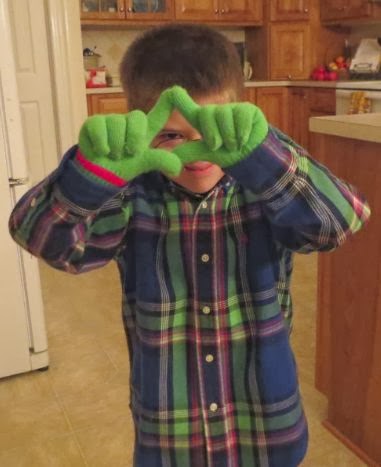
green gloves included.  

Which somehow reminds me of this:

When the light is green you go.
When the light is red you stop.
But what do you do
When the light turns blue
With orange and lavender spots?
                                              --Shel Silverstein

And that just may be the best illustration of parenting I have ever seen.  I know exactly what that blue traffic light with spots looks like.  

And then what do you do?  Well, you go up 'til it's clue and then open the box on the dots.*  **

  *Which being interpreted means "I don't know either."
** Which reminds me of my favorite blue spotted light moment ever.


Sunday, October 20, 2013

Remnants of Paradise


What is unconditional love?

I see it demonstrated often among those who have that extra chromosome. I see also the desire for it among many individuals without an extra chromosome as they beg others to be tolerant, non-judgmental, and unprejudiced.

I think of the two commandments: love God and love others.  And I wonder what it all really looks like lived out on an imperfect Earth.

Does loving Wade unconditionally mean that I accept his deficits without trying to change him?

Does giving him years of therapy mean that deep down I am really not happy with him the way he is?

Nathan is a young adult with Down syndrome.  His parents have decided to have him participate in trials for a drug which could greatly improve cognitive function in individuals with Trisomy 21.  They hope this will someday allow him to function more independently.

Many other parents refused to participate in the same research program because of fears that the son or daughter they loved would be fundamentally changed in some way.

Kaitlyn's mother decided to use growth hormone therapy when Kaitlyn was still quite young.  She felt that a more typical height would make Kaitlyn act more responsibly because people would realize how old she was and would expect more from her.

Roy Richard Grinker is an anthropologist who has written a book about autism and his experiences with his daughter Isabel.
Sometimes at night, Isabel has a hard time falling asleep.  It helps her if I sit in a chair in her bedroom.  Looking at her then, from across the room, I see two different Isabels. There is Isabel awake--often hyperactive and isolated--and Isabel asleep, a beautiful child drifting into a calm night.  And then I realize something unsettling:  I feel more affection for the sleeping Isabel.  She looks so peaceful and relaxed.  And I wonder what this says about me.  Do I love her less when she's a real person, awake and in the world?
                                   --from Unstrange Minds: Remapping the World of Autism


Robert Rummel-Hudson writes about his experiences with his daughter Schuyler who has a rare neurological disorder.  He speaks of the difficulty of maintaining a balance between unconditional love and advocacy.
 Schuyler's father has lost the balance between being the kind of dad who lets his daughter make mistakes so that she can learn from them and the kind who is there to keep her from wandering too far from herself. He struggles with the balance between accepting her for the astonishing human being that she is, and fighting to tear down the obstacles that have been unfairly and arbitrarily placed in her path. Her father’s advocacy is balanced very precariously, as it always has been.
                                                    -- from "Balances" at Support for Special Needs 

Walker is the son of journalist Ian Brown.  Walker was born with a genetic condition so rare that it is documented in perhaps 300 people worldwide.  The Boy in the Moon tells Walker's story with both the detachment of a journalist and the agony of a father.  In an interview, Ian Brown said he often hears parents of handicapped children say that they wouldn't change their children or trade them for anything.  "But I would," says Brown.  "I'd trade Walker...in an instant.  I wouldn't trade him for my sake, for our sake, but I would trade him for his sake."
Sometimes watching Walker is like looking at the moon: you see the face of the man in the moon, yet you know there's actually no man there. But if Walker is so insubstantial, why does he feel so important? What is he trying to show me? All I really want to know is what goes on inside his off-shaped head, in his jumped-up heart. But every time I ask, he somehow persuades me to look into my own.

So what is unconditional love?  Do these parents love their children any less for wanting to change them?  Absolutely not.  Their ragged, aching, vibrant and rending love is apparent in every word they write, in every step they advocate.

Do I love myself unconditionally?  I think I do.  Most of us do.  Do I ever wish to change myself?  Absolutely!

Do I love my other children?  Do I allow them to grow up unchecked and untrained simply because I love them unconditionally?  No, because that wouldn't really be love at all.

Couldn't we say that loving someone unconditionally is loving them for who they are while also seeing them for who they can be?  So then true love will mean doing my best with the knowledge I have at the moment to give my child the vision and ability to strive to be his best.   At the same time, I must also love him exactly as he is during the process.

Is that easy?  No, it isn't.  But as I spend my days trying to choreograph the delicate dance of love, I often catch faint glimpses of something else--wisps of something torn, but lovely.

These three authors above who express in poignant language their paradoxical love for their broken, beautiful children, also express their lack of belief in God, often citing anger toward him for the way they feel He has made their children suffer.

And yet....

Their devotion for their children is utter and complete to the point of a willingness to trade places with their children if possible.

That is unconditional love.

It is the same love God the Father felt for his broken beautiful children.  A love so great that he opened His arms wide and took our place.  A love so boundless that He died so we wouldn't have to.

But He knew that life would happen and we would become cynical and hurt and would cry out in anger against Him and refuse to believe Him.

And so he set Eternity in our hearts.  And he made dads and moms who love broken children.  And he gave us the desire to live in a perfect world and to strive for a more perfect world for the children that we love.

Our unconditional love is the remnant, torn though it may be, of the Paradise we first inhabited.

And it is the beginning of the way back.

If I find in myself desires which nothing in this world can satisfy, the only logical explanation is that I was made for another world.             
                                                                                                                    ---C. S. Lewis

He has made everything beautiful in its time.  He has also set eternity in the hearts of men.
                                                                                                                 Ecclesiastes 3:11


Saturday, October 19, 2013

Conversations


Wade (kissing me good-night):  Good-night, Bob the Builder!

Me:  I'm not Bob the Builder!  I'm mom!

Wade (chuckling delightedly):  Silly goose, Mother!


Wade:  I had a dream!

Me:  What was it about?

Wade:  Driving, elephant, mouse, and Dr. Vickery!

(This dream is not intended to bear any resemblance to a similar statement from Martin Luther King, Jr.)


Wade:   Chris, stop whistling or I'll slap your head!

Me:  WHAT????!!!!!!!!

Wade (loftily):  Never mind.  I was talking to Chris.


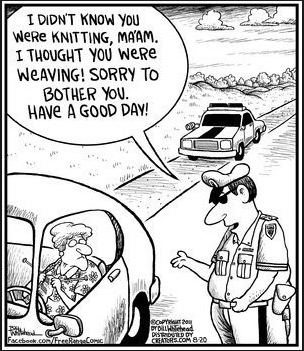
Chris (seriously):  Is there a law against knitting while you drive?

(Some conversations just leave me opening and shutting my mouth with no sound coming out.)


Friday, October 18, 2013

That Wasn't Quite What I Meant


Thursday morning, 3:15 a.m.  I see a light in the living room and go out to investigate.  Wade is sitting in the rocker reading Curious George.  I remind him that it's still night (see, it's dark outside!) and he agreeably lets me tuck him back in bed. (Go to sleep and stay in bed until a more appropriate time, please.)

Thursday evening.  I tuck Wade in bed.  The next day is a school field trip.  I tell him to stay in bed all night.  "If you wake up and it's still dark outside, just go back to sleep."  He agrees sweetly.

Friday morning.  Randall comes out to the kitchen.  "Mom, why in the world was the front porch light on at 6:00 this morning?"

Oh.  Guess I should have been more specific about what "still dark outside" means.

Thursday, October 17, 2013

Able!


A couple of years ago, spurred by changes in the economy, Nevin decided to end his career as a home builder.  An opportunity arose to begin a business producing sauces and dressings, and thus Woodside Kitchen was born.  Of course, it wasn't all quite that simple.  In reality, it included tearing out hair and sweating blood, but nevertheless, here we are today in a new realm.

A couple of important factors went into our decision:
  • we wanted to have work for Wade when he grows up
  • we wanted to teach responsibility to our other boys by working with them 
About the time when we were thinking most seriously about going through with this, we had a family come and talk to our support group who had two adults with Down syndrome, one biological and one adopted. These young people were well-mannered, capable, confident, and joyful.  In spite of good work ethics, however, they were having difficulty finding good employment.  As they and their parents shared their stories, it became apparent to us that much of the problem lay in finding an employer who understood and was willing to take the extra steps needed to make employment a success.

It occurred to us that evening that Woodside Kitchen (which was as yet unnamed and non-existent!) could provide the kind of environment and the type of work which could serve the disability community quite well.  And so we went forward, believing that this would be one of the most worthy goals for which we could strive.

Since then, we have read about a few other companies with similar goals.


Dye Creek Capital of Wilmington, NC, is an investment firm seeking to make a difference.  Young adults with various special needs are hired to greet clients, or tend to clerical or custodial tasks.  Ben and Amy Wright, the inspiration and owners of this business, are the parents of four children, two of whom have Down syndrome.

Their dedication to supporting those with disabilities is apparent right down to the pottery displayed in the lobby (by Christian Royal) and the paintings hung on the walls (by an art student who has Down syndrome).
Some [clients], understandably, are momentarily taken aback before heading upstairs to Ben's offices to talk finances and investment.
"If (interacting with the special staff) deters them, it's probably not the right fit with us anyway," Ben said. "Turns out, though, that our clients have embraced our business model as evidenced by the constant flow of thank you notes and letters of encouragement to our employees."
Amy echoed her husband's thoughts.
"We have witnessed time and time again when people with different abilities spend time together the walls come down," she said. "We believe putting our employees on the front end of our business, interacting with our clients, is a great way to tear down some of these walls."
You can read more about Dye Creek in this article:  "Investment Firm Buys into Hiring Special Needs Employees".


Habitat International is another inspiring businesses.
A leading supplier of artificial-grass and indoor-outdoor carpet products for The Home Depot, Lowe’s and other retailers, Habitat International Inc. is a socially responsible business dedicated to providing jobs for hard-to-place workers.
Launched by David Morris and his father Saul in 1981, the Chattanooga, Tennessee company has become a role model for other businesses, disability advocates and the general public.
Habitat's story has been told in the book Able.  One of the most fascinating things about this story is the work environment David Morris has been able to create by allowing his employees to make use of their unique talents to bond a sort of brotherhood where everyone feels needed and valued.  The statistics below (taken from the book) show that the value of the employees is real and not just a make-work-because-I-feel-sorry-for-you-program.

Without government assistance, Morris's company has prospered even in the economic downturn.  Habitat can boast:

  1. Zero back orders in 27 years.
  2. Product defect rate:  Less than one-half or 1 percent.
  3. Only one minor accident among the workers with disabilities.
  4. Practically no absenteeism.
  5. Very little turnover due to job dissatisfaction or firings.
  6. Cross-training for all employees, thereby ensuring job flexibility.
  7. Fewer supervisors, not more.  Employees are proud of what they can accomplish whether or not the boss is present.
  8. Less time and money spent tracking comparative data.


The video below further highlights what a role model Habitat has become for any business wanting to make a difference beyond the ordinary.


Visit NBCNews.com for breaking news, world news, and news about the economy

Wednesday, October 16, 2013

New Methods Required


Memory verses at school are a stretch for Wade.

The first few weeks were good because the verses were short.  At school, the children say the verse every time they are dismissed for break (what a wonderful practice!!) and I could tell that was helping him tremendously.  I also printed the verse and stuck it to the back of my driver's seat so it would be before his eyes as we traveled to and from school.   But as time goes on and the verses get longer and have words like exalteth and generations, the memory work is floundering.  Wade will start out saying this week's verse and then revert to a previous verse, especially if it has similar wording.

So this week, after some advice from the music therapist, we are trying a new method:  setting his verse to music.   The music certainly helps him to be actively and happily involved for 10 or 15 minutes working on learning it.  We'll keep experimenting every week and see how it helps.


Tuesday, October 15, 2013

Things I Liked about Today


I gave him a cup of milk to drink.
He poured it into a large kettle and said he was making sausage gravy.
Guess he was hungry.


My two other chefs made supper tonight (leftovers)...


...and finished it off with sweet tea (which they think should be part of all suppers).


And leaf fights should be part of every fall....


and fall should be part of every person. 


And look at that!  There really is an elf in the leaves!