Monday, February 20, 2012
Someone's Been Tampering with the Answers*
What is your name?
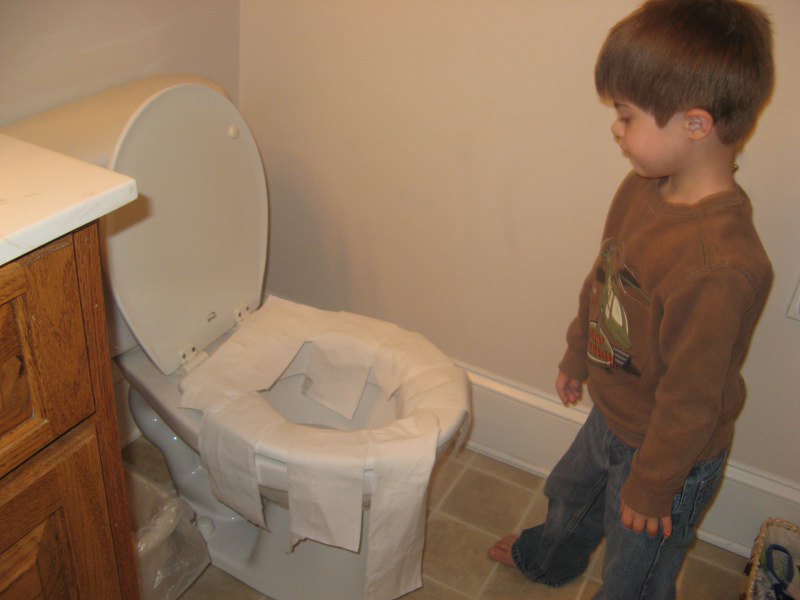
Wade: Pooh Strite!
Where do you live?
Wade: In a circus!
What do you want to drink, Chris?
Chris: Does Bud Light sell water?
*Disclaimer: We have no idea where the answers originate; we only know that if you ask, they will come.
Tuesday, February 14, 2012
Love Unclenched
Now I know I've got a heart, because it's breaking.
--The Tin Woodman in The Wizard of OzLast night, on the eve of the holiday dedicated to the celebration of love, I read a wrenching post entitled simply "Alone". From the torn heart of a dad, comes the cry we hear echoed far too often by those in our local Down syndrome support group: what do I do when my child with a disability doesn't have friends?
Many of these children are involved in classes and activities in which they have a social life of sorts. But at 3:00 or 5:00 when the class ends, so does the interaction.
Adults who have proved to be independent enough to live on their own also grapple with this loneliness, going home after work to spend the evening hours in solitude, often sinking into depression before their families discover the cause.
And each time I hear or read of another similar account, I worry about the kind of world we inhabit where this unconcern for others happens with such regularity. Are we really so shallow that we can only appreciate diversity under threat of the law, or through the coercion of outside forces? (And who of us would want a friend who was forced to grudgingly spare us an hour?)
Like so many parents caught in this uncertainty, I don't have the answers, only theories. But I'm going to venture to say that I don't believe most of humanity is that cold. I think they are only scared.
I remember the fear I had before I became acquainted with Wade. The fear of meeting others with disabilities, the fear of feeling uncomfortable in an unfamiliar world. What would I say? What would I do? What if I couldn't understand what they were saying? What if I said something inappropriate?
Now I realize that the sad thing about all of those "what ifs" is that they all were focused on me. What if I reach out and something happens to me? What if I get embarrassed/hurt/humiliated?
Perhaps I needed the shaking and cracking of my own heart to realize that real love isn't about me.
For it was then that I discovered the greatest "what if" of all. What if I were the one eating alone? What if it were my child? What would I want others to do? And then the answers became simpler. My embarrassment didn't matter at all. What really mattered was that, even if just for a moment, I made someone else feel valued and loved.
And I am learning that the greatest things I can do are to change myself and then to use that change to influence others. That's why for story time tonight, I read the post "Alone" to Randall and Chris. It opened the door to some good questions we might have otherwise missed asking ourselves.
I can't predict the future; I don't know how my children will respond when I am not present. But I can hope that I am planting seeds of compassion that will grow to influence others. And I can hope that as you have read this post, you have been influenced as well, and that tomorrow you will go out to greet the world, welcoming and unafraid.
Because you know what it feels to be human and to want love. And you know that you hold one of the keys to making a difference.
The question, "Why do children suffer?" has no answer, unless it's simply, "To break our hearts." Once our hearts get broken, they never fully heal. They always ache. But perhaps a broken heart is a more loving instrument. Perhaps only after our hearts have cracked wide open, have finally and totally unclenched, can we truly know love without boundaries.
--Fred Epstein, M.D., If I Get to Five
Tuesday, February 07, 2012
Montessori and More
I really never met Maria Montessori until I stumbled into her one day while absorbing massive amounts of information relating to the education of Wade.
I only wish I had met her years ago.
Science is just now beginning to document and verify what Maria learned 100 years ago from simply observing the way children learn best. She had no brain imaging, no way of seeing inside those little heads and yet she taught the children who were considered to be the unteachable and then applied her learning to all children everywhere. Brilliant.
I don't believe in rigid adherence to her pedagogy, but her methods can be applied anywhere there are children, parents, and teachers.
Practical life learning
Movement and balance awareness
Can you carry the bell without ringing it?
Can you balance the marble on the tee?
Hands-on learning and creating order by categorizing
Finding order through sequencing
Simplifying the variables
Early implementation of fine motor activities
(This picture, Wade says, is a robot holding his ears.)
Visuals, lots of visuals
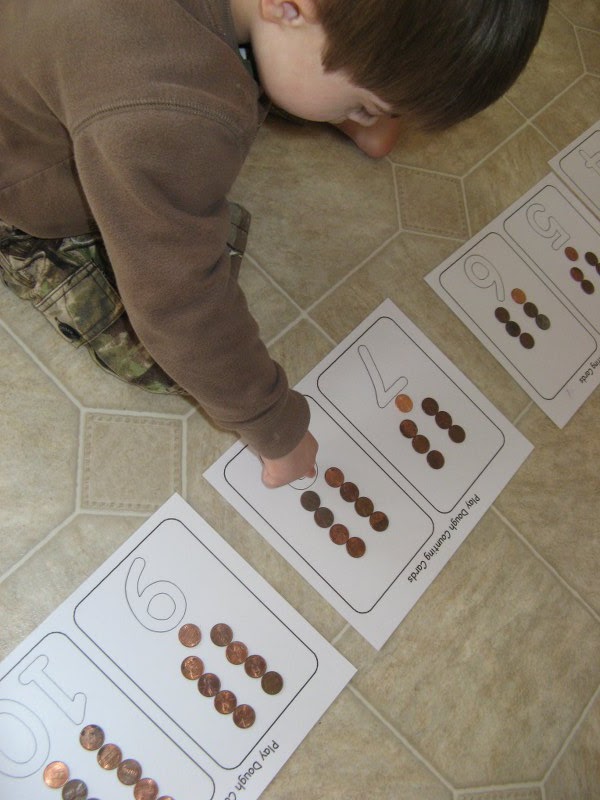
This is a terrific way to teach odd and even numbers. Line up your counters (pennies, buttons, or whatever) two by two. For the odd ones, put the leftover counter at the bottom center. Then run your finger down the center column while saying odd or even for each number. On the odd numbers your finger has to stop before hitting the number because it runs into the penny. On the even numbers, your finger can continue down the path to the number. What a great illustration for visual learners!
Okay, okay, this is not Montessori!
But it could fall under the category of "prepared environment".
*Links to further reading concerning Montessori learning
Wednesday, February 01, 2012
Mommy's Vocabulary Lesson
Drink until you hear a sneezle and then go show me something with a handle.
He drinks...
...he hears the sneezle (you can only hear sneezles at the bottom of your cup)
...he goes off in search of a handle....
Oh!
Well.......yes, Wade. I guess you're right.
That is a...
...........Handel.
Tuesday, January 24, 2012
Schuyler and Isabel: Message without Words
"...She was broken somehow, we knew that. But she wore her brokenness like a veil of stars."
--Robert Rummel-HudsonEvery journey is different. Every person is unique. Every disability is its own story.
Within the general categories of Down syndrome, autism, or cerebral palsy, live the individuals who in spite of some similarities of symptoms are still as varied as the hues of a summer day.
I often consider, therefore, when I write of our experiences with Wade, that our travels do not define either Down syndrome or disability for all others. We can only describe what we know, what we are learning on our own personal road of discovery.
And, yet, it is through the open doors of other parents that we are also allowed to partake of many different journeys which awaken in us the seeds of affinity and compassion for a broader scope of humanity than we could have imagined. It is a world of unusual richness and vitality, of brokenness and heartache, of truth and paradox.
Out of this tangled world of ambiguity, Schuyler's Monster comes to us--the memoir of a dad and his beloved daughter.
"It does not do to leave a dragon out of your calculations if you live near him," Tolkein has said.
But what about the monsters you can't see? You know they exist because you can see what they have done, but you don't know what they look like or who they are.
A known monster is still a monster, but you can at least plan your attack, assess his weak points, and rally your own strengths.
But how do you fight the Unknown?
This is Schuyler's story of the Monster who stole her voice, the Monster who is so rare that few have ever met him.
And as we read her story, our hearts ache with the raw voice of her father who feels that they are fighting the Monster with swords made of rubber. It is a story of sadness and joy, of anger and honesty, of doubt and of hope.
On any given day, I felt like Schuyler was visiting the rest of us here, a tiny being not of this world but trying as hard as she could to fit in. But it was different on Halloween night, watching Schuyler with her gauzy butterfly wings and her crazy pink hair and that braying, unashamed laugh, dancing to some wild and perfect music that the rest of us weren't allowed to hear. On a night like that, it was even easier for me to imagine Schuyler taking flight, her pink Converse hi-tops leaving the surface of this grand rough world for the last time.
I could imagine, with heartbreaking clarity and hand outstretched, watching Schuyler fluttering happily back to wherever she came from, whatever place in the universe exists where bug fairies speak in laughter and where sad, broken fathers aren't welcome.Rummel-Hudson speaks openly of his spiritual quest, calling himself an agnostic, but sharing his bitter angst with God after the diagnosis as well as his tender longing for a life with greater purpose, with something more.
"She is the source of my joy and my sorrow, and for all my resentment at him for giving her this burden, it is nevertheless when I am with Schuyler that I feel closest to God."
And that says it all so well. For in the enigma called Life, the journeys which bring us the closest to God are not necessarily those which are easy nor those which are easily understood.
Roy Richard Grinker, another father on a different journey, came to a similar conclusion as he wrote about his daughter Isabel in his book Unstrange Minds: "...there is something profoundly meaningful, if not spiritual, about being the father of a child with autism that has pushed me to consider lofty, abstract principles of life like truth, beauty, and goodness."
And I wonder as I read these fathers' accounts, separate and yet entwined, could it be possible that those who have no words sometimes speak with the greatest eloquence of all?
Tuesday, January 17, 2012
Art Worthy
It's a photography exhibition from the United Kingdom whose gentle mission has universal appeal:
"Look at the individual and not the condition."
Every so often I read descriptions which delicately refer to people who "suffer from Down syndrome". And every time it makes me laugh because I wonder about the people who seem to "suffer from normalcy".
Join us in watching this slideshow where no one seems to be suffering from anything and where the individual is recognized before the label.
Bailey and the other photographers continue to document new images of Down Syndrome through a generous grant from GlaxoSmithKline in the UK. To find out more information and see the photographs, visit: shiftingperspectives.org.
Tuesday, January 10, 2012
Bless Winnie the Pooh and Me Too
Wade had surgery today to have the fourth tube inserted in the right ear, which was once again full of fluid, and a temporary patch over the perforation in the left ear. We are looking forward to the improvement of both his hearing and ours. One day last week after we had turned his (VERY LOUD) music down to reasonable levels, I came into the living room to find him up on the bookcase with his ear pathetically pressed to the speaker. Sad.
The doctor added some type of adhesive to the top side of the tube this time to encourage a longer period of function. Other than super glue, he said, that's about all he could do.
The perforation in the left eardrum is larger than I had envisioned and has really not healed over much as we had hoped since the last surgery. It currently encompasses about 60% of the surface space. The patch will last around six weeks during which time we hope it will encourage new growth and healing. The patch itself will facilitate better temporary hearing by providing more surface area for vibration.
Dr. Vickery said that Wade had better add himself and his left ear to his daily prayers for Winnie the Pooh and Mickey Mouse.
What a nice nurse with an interesting finger tickler!
Off to surgery. Great ride. They treat me like a prince!
Ahhhhh! Breathing in the essence of candy-infused sleep medicine. (Wade loved that and happily breathed it until the mask fell out of his sleepy hand. Then he giggled and went off to sleep. Happy medicine at its best!)
Home again. Relaxing with Winnie the Pooh.
Monday, January 02, 2012
He Said What?
It's bedtime.
Wade pulls off his shirt, points at the two little bumps on his chest and says proudly, "Pickles!"
My question is this: if I remind him of the anatomically correct term, will I be sorry?
Thursday, December 29, 2011
That's the Way It Is
That's Wade. Another ENT visit. Fluid still present after fighting it all fall. Fourth ear tube surgery scheduled.
That's Randall. Root canal for a front tooth he injured last Christmas.
That's the clothesline. Broken.
That's Monopoly. A nice safe activity in which boys don't break teeth or clotheslines.
Sunday, December 25, 2011
Fear Not
Maybe you couldn't find your child in a busy store....and 5 minutes felt like an hour.
Maybe you received a medical diagnosis that made you afraid of the future--or of no future.
Maybe you felt a knot in your stomach (not too much, but just a little bit you know) at the logistics of setting up a new business in a poor economy.
Maybe you were afraid of what can't be explained.
Maybe you were afraid of the truth.
Maybe you wish an angel would appear to you and say, "Fear not!"
In the linking of what appeared to be separate instances, I had an "aha" moment this week complete with two stunning visuals to help me remember to fear not without an angel. Or maybe there was one. Who knows?
Never doubt that God can't work through YouTube.
Nevin had shown me the first video a few weeks ago, a matter of physics and pendulum waves and patterns of movement that cycle through moments of being in sync, then apparently chaotic, and then back in sync again. "Wow!" I said, "Cool!" and went on with my day's work.
On Thursday, our neighbor who creates metal sculptures, called us to come and see his latest creation he had just finished out of pieces from an old restored mill building in town. He had centered the design around an old scale from the building and had incorporated working parts with chain pulleys and big wheels. He had echoed the lollipop shape of the scale in several other metal lollipop pieces, some fixed on the back of the sculpture and some free-swinging on two of the large wheels at the top.
I was fascinated with how much those lollipops reminded me of the seats on a ferris wheel as the wheel spun. But then at certain points they seemed to move at random, flinging themselves in every direction instead of moving smoothly. "There is a mathematical term for that," said Mr. Finch, "and they are not chaotic although they appear to be."
Hmmm. Something began to click. Was it random that the same idea appeared before me twice within a few short weeks?
I don't think so.
Look at these two videos, the first a visual symphony of uncoupled pendulums and the second a computer-generated music box of movement called digital harmony.
Notice the moments in each one where the movement appears to be random, chaotic, without reason.
Then notice how it all comes back together into a beautiful dance of rhythm and order.
And as you watch, think....
...about the Divine Master who created the laws of the universe
...about that same Supreme Being Who knew the rules well enough to break them and send a tiny baby--half human, half God--into a chaotic world
...about a baby who brought with Him the love that makes beautiful harmonic order out of brokenness
...about a baby whose life gave us the purpose to move through apparent randomness toward a predictable goal
...about a baby who taught us that what appears to be random, isn't.
And you might just carry these visuals in your heart to help you move through the moments of fear in a new year.
Or you might just say, "Wow! Cool!" and walk away.
The choice is yours and mine.
Click on the link below to start the animation.
Music Box
Music Box
Subscribe to:
Posts (Atom)